How Vaping Works
Strip away the marketing and an e-cigarette is a surprisingly simple machine. It has four working parts — a power source, a heating element, something to carry the liquid, and the liquid itself — and understanding how they fit together explains almost everything else about vaping, including why it is chemically different from smoking. This page describes each part in plain language. It is educational only; it is not a how-to buy or how-to use guide.
Independent educational resource. Vapor Hub is an information-only reference. Nothing here is for sale, and nothing here encourages anyone to start using nicotine. Intended for adults of legal age (18+ in the UK and EU, 21+ in the United States). This is not medical advice — speak with a qualified professional about your own health. If you do not smoke or vape, the best choice is not to start.
The core idea: heat, not fire
A traditional cigarette works by combustion. When you light tobacco it burns at several hundred degrees, and that burning creates thousands of new chemical compounds — tar, carbon monoxide, and many known carcinogens — in the smoke. An e-cigarette does not burn anything. Instead it gently heats a liquid until it turns into an aerosol, a suspension of tiny droplets in air that people call “vapour.” Because there is no fire and no tobacco leaf, the aerosol contains a different, and generally far smaller, set of chemicals than cigarette smoke. This distinction between burning and heating is the single most important concept in the whole subject, and it is why the Cancer Research UK position is that vaping is far less harmful than smoking — though not harmless.
Part one: the battery
Every vape is powered by a rechargeable lithium-ion battery. In a small disposable or pod device the cell is sealed inside; in larger devices it may be a removable cylindrical cell such as an 18650 or 21700. The battery’s job is to deliver a burst of current to the heating coil when you activate the device. Because lithium cells store a lot of energy in a small space, they are also the one part of a vape that can be genuinely dangerous if mistreated — a topic serious enough that we cover it separately on the battery safety page.
Part two: the atomiser coil
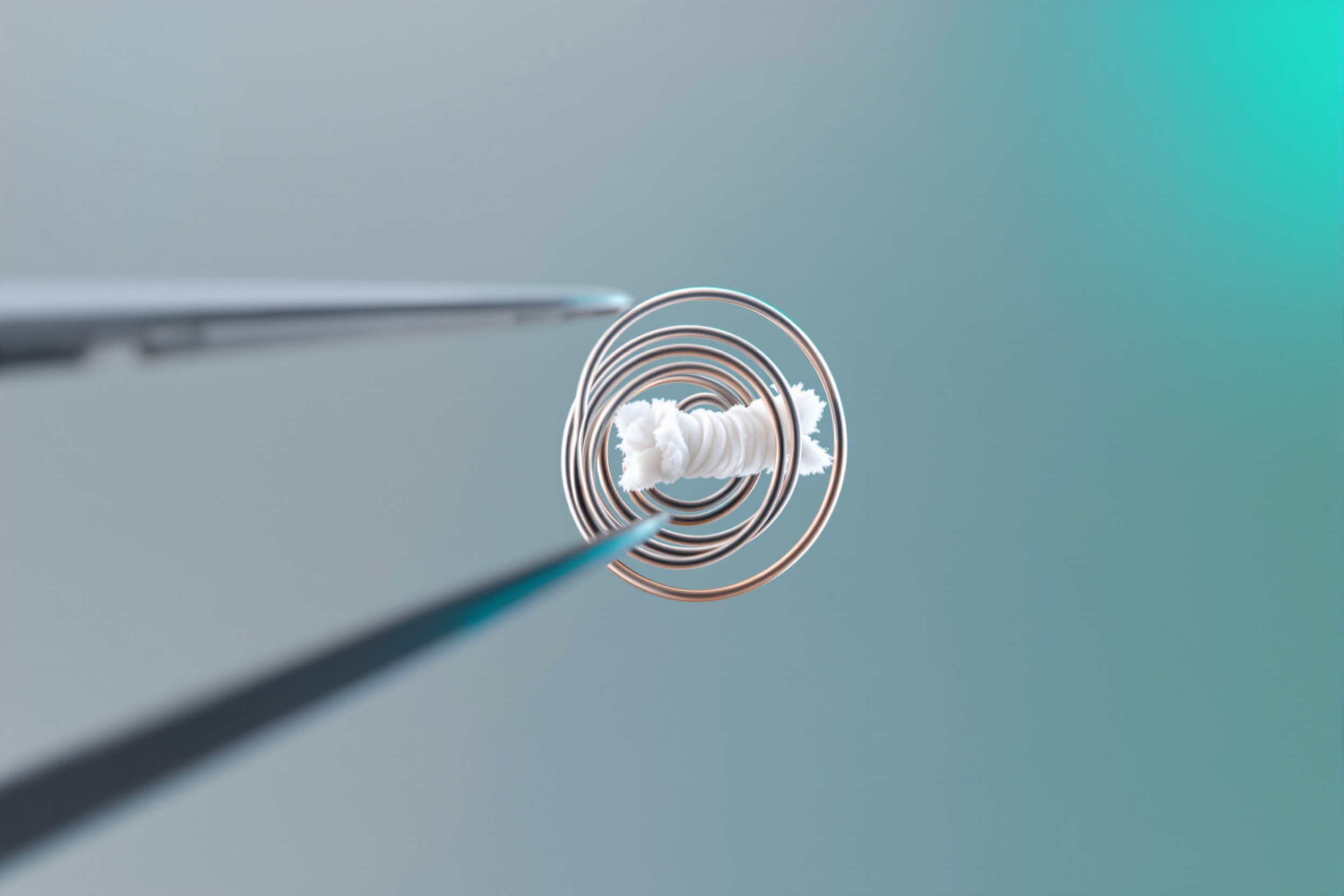
The coil is the heating element. It is usually a short length of resistance wire — wound into a spiral — that heats up when current passes through it, exactly like the element in a toaster. The coil’s resistance, measured in ohms, determines how much power it draws and how hot it runs. Lower-resistance “sub-ohm” coils produce more heat and more aerosol; higher-resistance coils produce less. In most modern devices the coil sits inside a small replaceable pod or head, so users are not expected to build anything themselves.
Part three: the wick
A coil on its own would simply scorch. The wick — typically organic cotton — sits in contact with the coil and draws liquid up to it by capillary action, the same way a paper towel soaks up a spill. When the coil heats, it vaporises the liquid held in the saturated wick rather than burning the wick itself. If the wick runs dry, the cotton scorches and produces the harsh, acrid “dry hit” that vapers universally dislike — a built-in signal that the device needs more liquid.
Part four: the e-liquid
The liquid is what actually becomes aerosol. It is built from two base fluids — propylene glycol (PG) and vegetable glycerine (VG) — plus flavourings and, optionally, nicotine. The ratio of PG to VG changes how the aerosol feels and how much of it is produced. We break the ingredients down in detail, including their safety history, on the e-liquid page.
Putting it together: one puff, step by step
When a user activates the device — either by pressing a button or simply by inhaling, which triggers an airflow sensor — the battery sends current to the coil. The coil heats within a fraction of a second. The liquid held in the wick around the coil reaches its vaporisation point and turns into an aerosol, which is carried by incoming air through a mouthpiece and inhaled. When the user stops, the coil cools almost immediately. There is no smouldering ember and nothing continues to burn between puffs, which is also why an idle vape does not produce sidestream smoke the way a resting cigarette does.
Why the details matter
Understanding the mechanism helps cut through confusion. “Vapour” is really an aerosol, not water vapour, and it does contain nicotine and trace compounds — so it is not harmless mist. At the same time, the absence of combustion is exactly why bodies such as the U.S. Food and Drug Administration classify these as a distinct product category with their own risks and rules rather than treating them as identical to cigarettes. Knowing what the machine actually does lets you read the health debate on its own terms.
Next, see the different types of device these four parts are packaged into, or jump to the glossary if a term is unfamiliar.