Types of Vaping Devices
Vaping hardware has evolved into a sprawling family of shapes and names, and the vocabulary can be genuinely bewildering. This page is a descriptive map of that family. It explains what each category of device is and how the categories differ in power, complexity and intended user — nothing more. There is no buying advice here, no recommendations, and no products for sale; this is background knowledge so the terminology makes sense.
Independent educational resource. Vapor Hub is an information-only reference. Nothing here is for sale, and nothing here encourages anyone to start using nicotine. Intended for adults of legal age (18+ in the UK and EU, 21+ in the United States). This is not medical advice — speak with a qualified professional about your own health. If you do not smoke or vape, the best choice is not to start.
Cig-a-likes and disposables
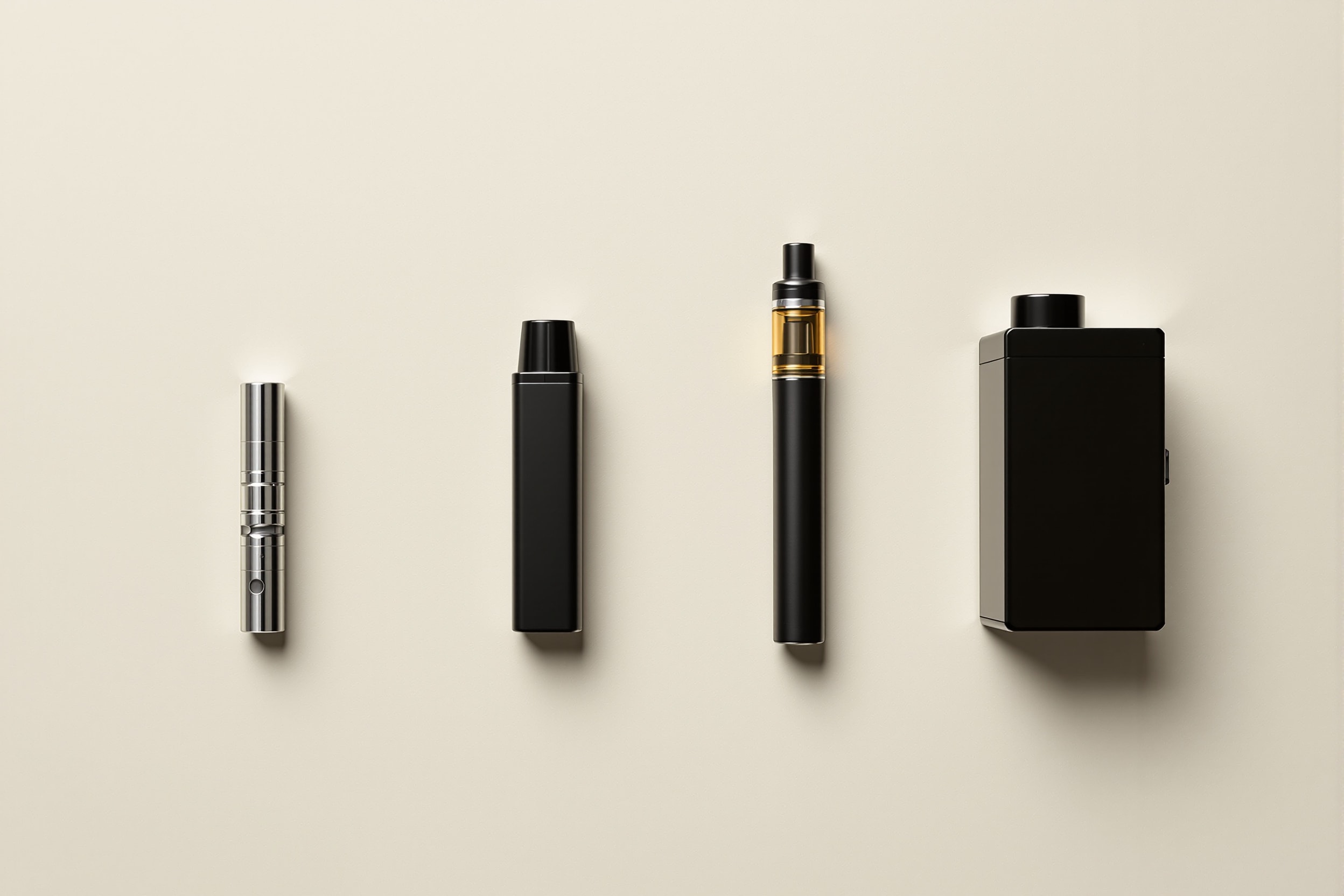
The earliest e-cigarettes were designed to look and feel like a cigarette — hence “cig-a-like.” Their modern descendant is the disposable: a small sealed unit pre-filled with e-liquid and a non-removable battery, used until empty and then discarded. They are the simplest possible form factor, with no settings and nothing to refill. Their simplicity is also why regulators watch them closely: because they are cheap and low-effort, disposables have been at the centre of debates about youth uptake and, increasingly, about electronic waste, which several jurisdictions now cite in restricting or banning them.
Pod systems
A pod system splits the device into two parts: a reusable battery “body” and a small replaceable or refillable “pod” that holds the liquid and coil. Pods are compact, usually low-power, and often paired with higher-strength nicotine-salt liquids that deliver nicotine smoothly. They became the dominant format for adults switching from cigarettes because they are convenient and require little maintenance. Closed-pod systems use pre-filled pods; open-pod systems let the user add their own liquid.
Vape pens
The vape pen is a cylindrical mid-size device: bigger than a pod, with a larger battery and a refillable tank, but still straightforward to use. Pens were the mainstream step up for many years and remain popular for their balance of capacity and simplicity. Most have a single activation button and a tank that unscrews for refilling and coil changes.
Box mods
A box mod is a larger, box-shaped device built around one or more removable batteries and a circuit board that lets the user regulate power. “Mod” is short for “modified” — a nod to the hobbyist origins of the hardware. A regulated box mod includes electronic safeguards: it lets the user set wattage or temperature and will refuse to fire in unsafe conditions, such as a short circuit or a critically low battery. Box mods pair with a wide range of tanks and are aimed at experienced users who want control over the experience.
Mechanical mods
A mechanical mod (“mech mod”) is the opposite philosophy: a simple metal tube or box that connects the battery directly to the coil with no circuit board, no regulation, and no safety cut-offs. Because nothing limits the current, a mechanical mod relies entirely on the user understanding battery limits and Ohm’s law. This makes them strictly advanced hardware; the absence of protection is precisely why our battery safety page matters most to anyone who encounters one. We describe mechanical mods here for completeness, not as a recommendation — for most people a regulated device is the sensible category.
Tanks, RDAs, RTAs and RDTAs
Above the battery sits the part that holds liquid and houses the coil. A sealed tank uses pre-made replaceable coil heads and is the standard, low-maintenance choice. The “R” families are rebuildable atomisers for hobbyists who build their own coils and wicks:
- RDA — Rebuildable Dripping Atomiser: liquid is dripped directly onto the coil and wick a few drops at a time, with no reservoir.
- RTA — Rebuildable Tank Atomiser: a rebuildable deck sitting above a tank that feeds it liquid.
- RDTA — Rebuildable Dripping Tank Atomiser: a hybrid with a reservoir beneath the build deck.
These rebuildable formats are why terms like “coil building” and “sub-ohm” exist. They are advanced, hands-on equipment; we explain the words so you can read them elsewhere, not to encourage anyone to take up building.
Nicotine strength and format matter as much as hardware
Two identical-looking devices can deliver very different amounts of nicotine depending on the liquid inside them and the power they run at. A low-power pod with nicotine-salt liquid and a high-power sub-ohm tank with freebase liquid are different experiences even though both are “vapes.” That interaction between hardware and liquid is covered on the e-liquid page.
The direction of travel
Over time the market has generally moved from complex, hobbyist hardware toward simpler devices aimed at adult smokers who want to switch with minimal fuss — and, in parallel, toward tighter rules on the very simplest disposables. The UK Office for Health Improvement and Disparities evidence review and the FDA both track these categories because the format affects both potential benefit and potential harm. Understanding the hardware is the first step to reading those debates clearly.